Overview

This guide demonstrates how to add embedded wallets to your existing React app with just a few lines of code.
Check out the CDP Web SDK reference for comprehensive method signatures, types, and examples.
Already have user authentication? If you’re using Auth0, Firebase, AWS Cognito, or another identity provider, check out Custom Authentication to integrate with your existing auth system.
An embedded wallet is a self-custodial crypto wallet built directly into your app. Unlike traditional wallets (like MetaMask) that require browser extensions and seed phrases, embedded wallets let users sign in with familiar auth methods such as email, mobile SMS, and OAuth while maintaining full control of their assets.Key benefits:
  • No downloads: Works instantly in any browser
  • Email sign-in: No seed phrases to manage, but users retain full control
  • You control the UX: Seamlessly integrated into your app
Choose your path:

Integrate into your app

Continue reading to add embedded wallets to your current React app with a few lines of code.

Check out our template app

Build a complete demo app from scratch to learn all the features.

Prerequisites

  • A free CDP Portal account and project
  • Node.js 22+
  • A node package manager installed (i.e., npm, pnpm, or yarn)
  • Basic familiarity with React and TypeScript
  • Configured your domain in CDP Portal (see below)
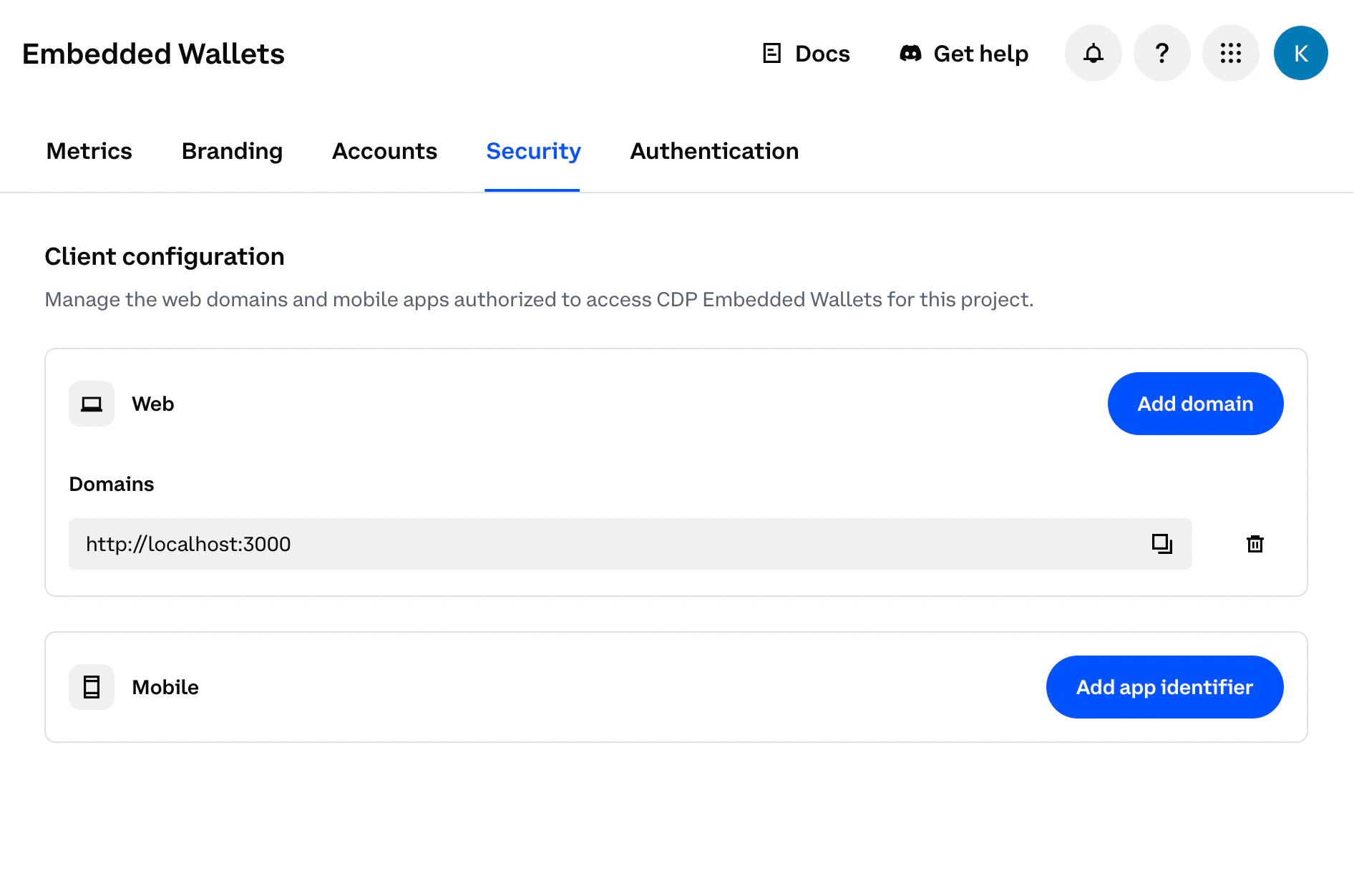
Step 1: Access CDP PortalNavigate to the Security Configuration in CDP Portal, and click Add domain to include your local app.
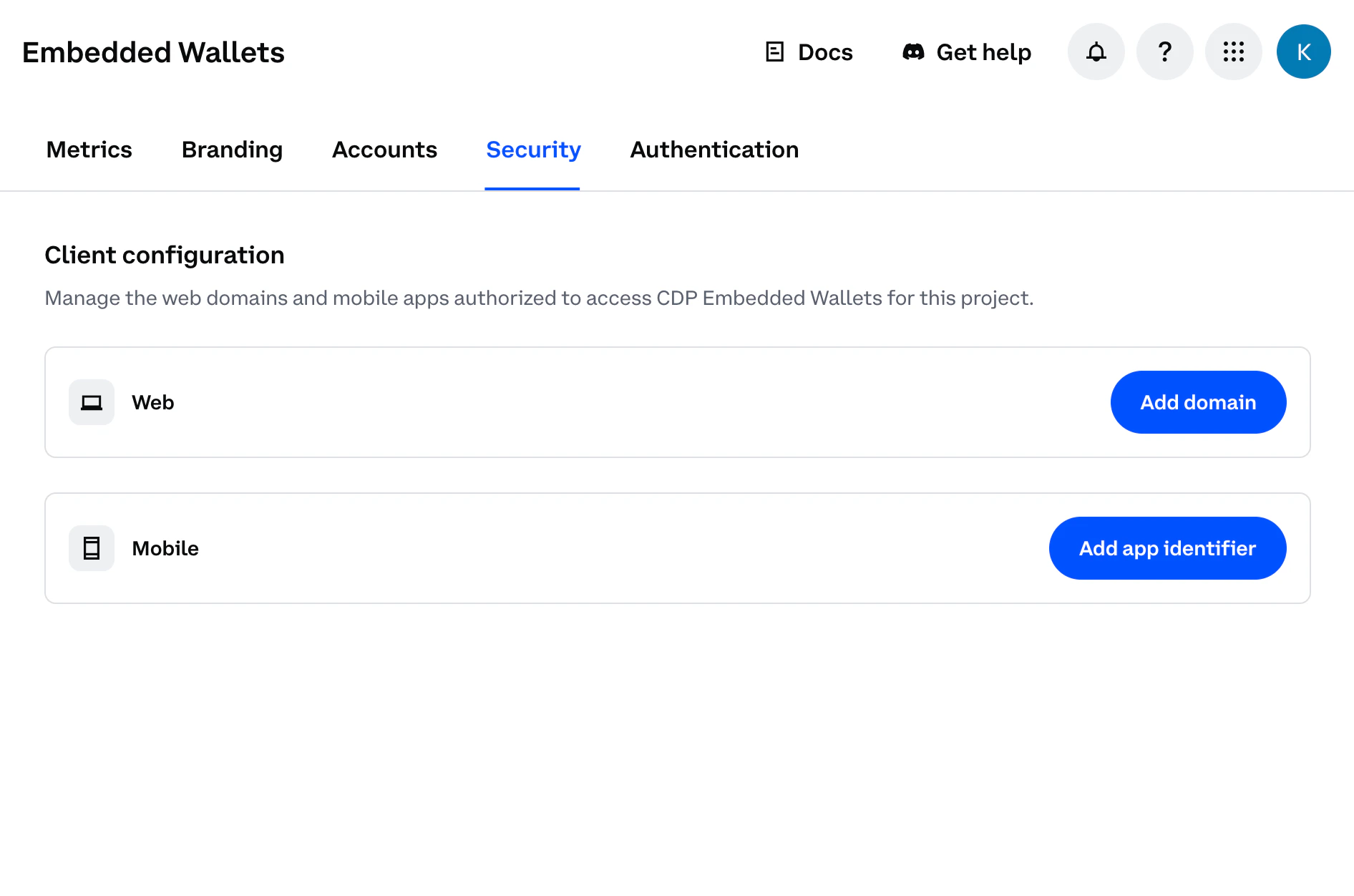
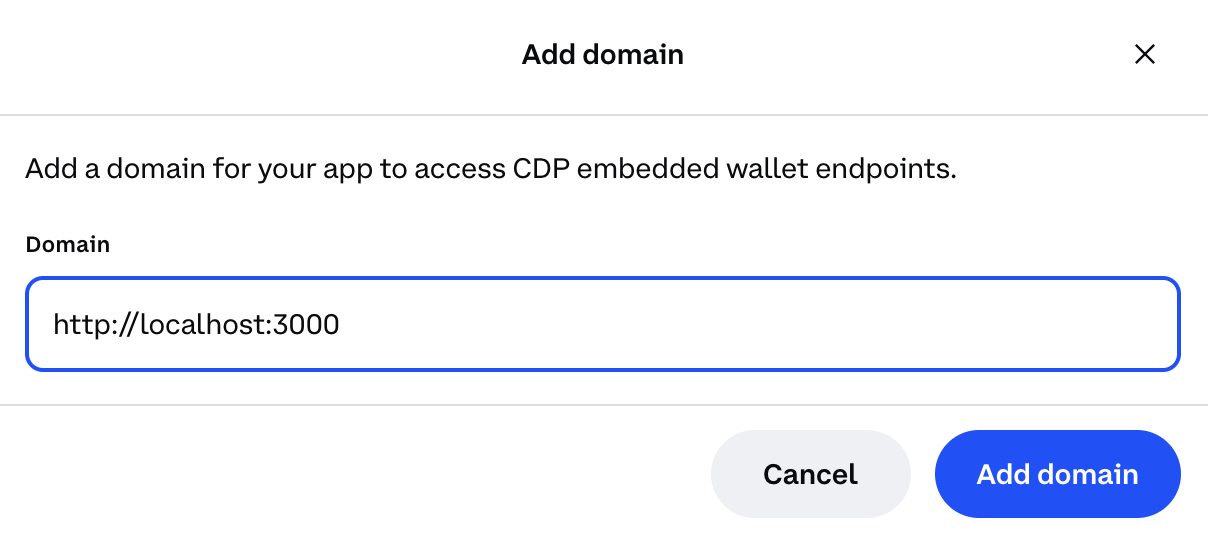
Add domain dialog in CDP Portal
Step 2: Add your domain
  • For local development: Use http://localhost:3000 (or your preferred port)
  • For production: Use your actual domain (e.g., https://yourapp.com)
Domain configuration with localhost
For production apps, only add your actual production domain. Do not add localhost to production CDP projects as malicious apps running locally could impersonate your frontend and abuse your project credentials.
Step 3: Save your changesClick Add domain again to save your changes.
Domain configuration saved in CDP Portal
You should see your domain listed in the CDP Portal dashboard. The allowlist will take effect immediately upon saving.

1. Install packages

Once you’ve completed the prerequisites above, install the required packages:
npm install @coinbase/cdp-react @coinbase/cdp-core @coinbase/cdp-hooks

2. Wrap your app with the provider

Add the CDP provider to your root component (typically App.tsx or main.tsx). Replace "your-project-id" with your actual project ID from CDP Portal.
import { CDPReactProvider } from "@coinbase/cdp-react";

function App() {
  return (
    <CDPReactProvider
      config={{
        projectId: "your-project-id",
        ethereum: { // if you want to create an EVM account on login
          createOnLogin: "eoa" // or "smart" for smart accounts
        },
        solana: { // if you want to create a Solana account on login
          createOnLogin: true
        },
        appName: "Your App Name"
      }}
    >
      <YourExistingApp />
    </CDPReactProvider>
  );
}

3. Add authentication

The simplest approach is to use the AuthButton component which handles the entire authentication flow:
import { AuthButton } from "@coinbase/cdp-react/components/AuthButton";
import { useIsSignedIn } from "@coinbase/cdp-hooks";

function AuthComponent() {
  const { isSignedIn } = useIsSignedIn();

  return (
    <div>
      {isSignedIn ? (
        <div>Welcome! You're signed in.</div>
      ) : (
        <div>
          <h2>Please sign in</h2>
          <AuthButton />
        </div>
      )}
    </div>
  );
}

Option B: Build custom auth UI

For custom UIs, use the authentication hooks directly:
function CustomAuthComponent() {
    const { signInWithEmail } = useSignInWithEmail();
    const { verifyEmailOTP } = useVerifyEmailOTP();
    const { isSignedIn } = useIsSignedIn();
    const [flowId, setFlowId] = useState<string | null>(null);
    const [email, setEmail] = useState('');
    const [otp, setOtp] = useState('');

    const handleEmailSubmit = async () => {
        if (!email) return;
        try {
            const result = await signInWithEmail({ email });
            setFlowId(result.flowId);
        } catch (error) {
            console.error("Sign in failed:", error);
        }
    };

    const handleOtpSubmit = async () => {
        if (!flowId || !otp) return;
        try {
            const { user } = await verifyEmailOTP({ flowId, otp });
            console.log("Signed in!", user.evmAccounts?.[0]);
        } catch (error) {
            console.error("OTP verification failed:", error);
        }
    };

    if (isSignedIn) {
        return <div>Welcome! You're signed in.</div>;
    }

    return (
        <div>
            {flowId ? (
                <div>
                    <h2>Enter OTP</h2>
                    <input type="text" value={otp} onChange={(e) => setOtp(e.target.value)} placeholder="Enter OTP code" />
                    <button onClick={handleOtpSubmit}>Verify OTP</button>
                </div>
            ) : (
              <div>
                <h2>Sign in with Email</h2>
                <input type="email" value={email} onChange={(e) => setEmail(e.target.value)} placeholder="Enter your email" />
                <button onClick={handleEmailSubmit}>Send OTP</button>
              </div>
            )}
        </div>
    );
}

4. Send transactions

EVM transactions

Once authenticated, users automatically get a wallet address. Here’s how to send EVM transactions:
import { useEvmAddress } from "@coinbase/cdp-hooks";
import { SendEvmTransactionButton } from "@coinbase/cdp-react";

function SendTransaction(){
    const { evmAddress } = useEvmAddress();
    return (
        <div>
            <div>
                <h2>Send Transaction</h2>
                {evmAddress ? (
                  <SendEvmTransactionButton
                    account={evmAddress}
                    network="base-sepolia"
                    transaction={{
                        to: evmAddress,
                        value: 1000000000000n,
                        chainId: 84532,
                        type: "eip1559",
                    }}
                    onSuccess={(hash) => {
                        console.log('Transaction successful:', hash);
                        alert(`Transaction sent! Hash: ${hash}`);
                    }}
                    onError={(error) => {
                        console.error('Transaction failed:', error);
                        alert(`Transaction failed: ${error.message}`);
                    }}
                    pendingLabel="Sending transaction..."
                  />
                ) : (
                    <p>Wallet not ready yet...</p>
                )}
            </div>
        </div>
    );
}
That’s it! Your users now have embedded wallets and can send transactions.

Solana transactions

Here’s how to send Solana transactions:
import { useSolanaAddress } from "@coinbase/cdp-hooks";
import { SendSolanaTransactionButton } from "@coinbase/cdp-react";

function SendTransaction(){
    const { solanaAddress } = useSolanaAddress();
    return (
        <div>
            <div>
                <h2>Send Transaction</h2>
                {solanaAddress ? (
                  <SendSolanaTransactionButton
                    account={solanaAddress}
                    network="solana-devnet"
                    transaction="base64-solana-transaction"
                    pendingLabel="Sending transaction..."
                  />
                ) : (
                    <p>Wallet not ready yet...</p>
                )}
            </div>
        </div>
    );
}
For more details on building Solana transactions, error handling, and advanced examples, see Solana Sending Transactions.

Demo app tutorial

Build a complete demo app to learn all features in depth

React Hooks

Explore all available hooks for advanced functionality

React Components

Use pre-built components for faster development

Next.js Integration

Learn about “use client” requirements and setup
Need testnet funds? Get free Base Sepolia ETH from the Base Faucet to test transactions.